
China Sunscreen Market Report — April 2026
An AI-assisted market report based on 264 Taobao sunscreen search results and 140 cleaned product listings, covering price bands, claim structures, use-case segments, and complaint opportunities.
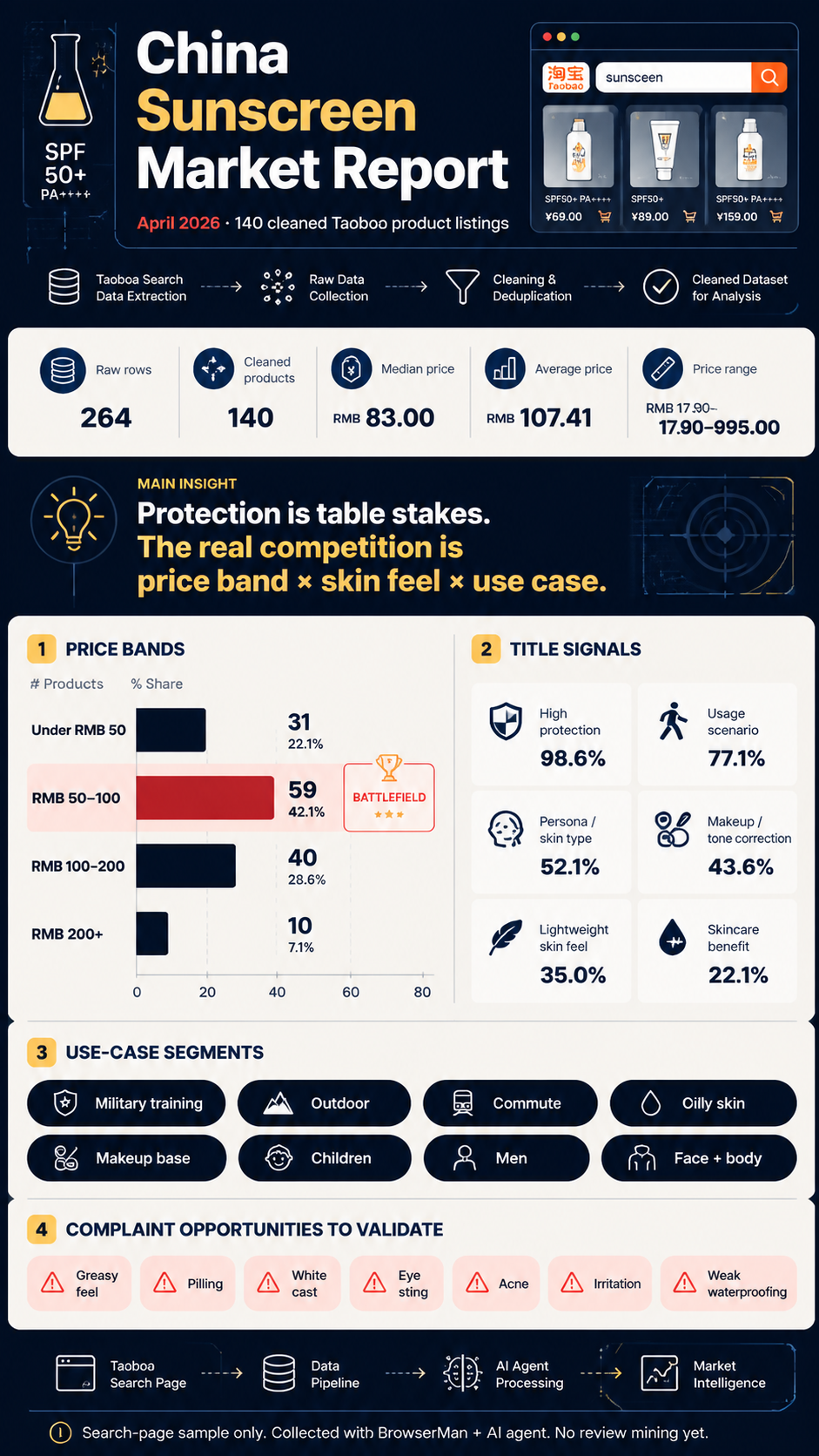
Chinese sunscreen listings are no longer competing on SPF alone.
In April 2026, we used BrowserMan and an AI agent to collect Taobao search results across six sunscreen-related queries, then cleaned the output into a 140-product sample. The result is a sharper picture of how sunscreen products are being positioned in China’s ecommerce market.
The short version:
The Chinese sunscreen market is shifting from protection claims to price-band strategy × skin-feel promises × use-case segmentation.
High protection is now table stakes. The real competition is around who the product is for, when it will be used, and what bad experience it promises to avoid: greasiness, pilling, white cast, eye sting, acne, irritation, weak waterproofing, or inconvenient reapplication.
Method and sample
This report is based on Taobao search-result data collected in April 2026.
We expanded the sample beyond a single query by searching six related terms:
- 防晒霜 — sunscreen cream,
- 防晒乳 — sunscreen lotion,
- 防晒喷雾 — sunscreen spray,
- 儿童防晒霜 — children’s sunscreen,
- 男士防晒霜 — men’s sunscreen,
- 油皮防晒霜 — sunscreen for oily skin.
Across those searches, the raw extraction returned 264 search-result rows. After deduplication and filtering out irrelevant results, such as car covers, bottles, test cards, and non-cosmetic “sun protection” products, we kept 140 cleaned sunscreen product listings.
The agent extracted visible search-page fields:
- product title,
- price,
- sales text,
- shop name,
- product URL,
- source query.
This is still a search-page market sample, not a full retail audit. It does not include product-detail-page copy, image OCR, review mining, or verified exact sales counts.
The workflow behind this report is described separately in How to Use AI Agents for Market Analysis: A Taobao Workflow. The key idea is simple: AI market analysis should start with real market data collection, not with a blank prompt asking for conclusions.
Key numbers
The cleaned 140-product sample shows a market centered around accessible mid-range pricing, with a long premium tail.
| Metric | Value |
|---|---|
| Raw search-result rows | 264 |
| Cleaned sunscreen product listings | 140 |
| Lowest price | RMB 17.90 |
| Highest price | RMB 995.00 |
| Median price | RMB 83.00 |
| Average price | RMB 107.41 |
The price range is wide, but the market center is clear: most visible products sit below RMB 200, and the strongest cluster sits between RMB 50 and RMB 100.
Finding 1: RMB 50-100 is the visible battlefield
Price distribution across the 140-product cleaned sample:
| Price band | Products | Share | Median price |
|---|---|---|---|
| Under RMB 50 | 31 | 22.1% | 37.90 |
| RMB 50-100 | 59 | 42.1% | 75.00 |
| RMB 100-200 | 40 | 28.6% | 132.74 |
| RMB 200+ | 10 | 7.1% | 289.74 |
The largest band is RMB 50-100, with 42.1% of the sample.
That band is not simply “cheap sunscreen.” It contains mass-market products, imported brands, domestic brands, children’s sunscreen, men’s sunscreen, oily-skin sunscreen, body sunscreen, and scenario-driven products for outdoor use or military training.
The RMB 100-200 band looks like the performance and brand-confidence zone. Products here more often lean on recognizable brand names, imported positioning, higher SPF claims, skincare benefits, or specialized use cases.
Above RMB 200, the sample becomes a smaller premium tail: high-end imported products, multi-product bundles, or specialist formulations.
The pricing implication is direct:
- If a product sits below RMB 50, it needs a clear volume, entry-level, or trial logic.
- If it sits at RMB 50-100, it needs sharper differentiation because that is the densest competitive zone.
- If it sits at RMB 100-200, it needs to explain why it deserves a premium.
- If it sits above RMB 200, it needs brand trust, formulation credibility, or luxury/skincare positioning.
Finding 2: high protection is no longer enough
We classified product titles into six claim groups.
| Title signal | Products matched | Share |
|---|---|---|
| High protection | 138 | 98.6% |
| Usage scenario | 108 | 77.1% |
| Persona / skin type | 73 | 52.1% |
| Makeup / tone correction | 61 | 43.6% |
| Lightweight skin feel | 49 | 35.0% |
| Skincare / functional benefit | 31 | 22.1% |
Almost every listing uses high-protection language: SPF, PA, UV, high-protection, anti-ultraviolet, waterproof, or related terms.
That means high protection is no longer a differentiator. It is the price of entry.
The more interesting signals are the second-layer claims:
- usage scenario: outdoor, military training, commute, beach, face, body, children, men;
- persona and skin type: oily skin, dry skin, sensitive skin, babies, students, men;
- makeup and tone correction: primer, tone-up, whitening, no white cast, makeup-friendly;
- lightweight feel: refreshing, non-greasy, water-light, gel texture, no pilling;
- skincare benefit: repair, moisturizing, soothing, anti-photoaging, brightening.
The market language is moving from “this blocks the sun” to “this solves a specific user situation without creating a new problem.”
Finding 3: the category is splitting into use-case markets
The most useful way to read this market is not by brand alone.
It is by task.
A buyer is not only asking “which sunscreen is best?” They are often asking a much more specific question:
- What can I use during military training?
- What will not feel greasy on oily skin?
- What works under makeup?
- What is safe enough for children?
- What can I use on both face and body?
- What will not leave a white cast?
- What will survive sweat and outdoor use?
This creates a set of content and positioning segments:
| Segment | Buyer anxiety | Better content angle |
|---|---|---|
| Military training / outdoor | sweat, sunburn, reapplication | waterproofing, durability, reapplication routines |
| Daily commute | greasiness, inconvenience | lightweight everyday sunscreen logic |
| Oily skin | shine, clogged pores, heavy film | oil-control and non-greasy evaluation criteria |
| Makeup base | pilling, white cast, poor fit | sunscreen-under-makeup compatibility |
| Children | irritation, safety, outdoor exposure | physical sunscreen and gentle formulas |
| Men | white cast, stickiness, hassle | low-friction sunscreen routines |
| Face and body | cost, volume, comfort | large-format and multi-use tradeoffs |
This is where market analysis becomes useful for content strategy.
A generic “best sunscreen” article competes with everyone. A specific angle like “sunscreen for oily skin during summer commuting” gives a brand a much sharper entry point.
Finding 4: the opportunity is hidden in avoided failures
Positive claims in product titles often point to negative experiences sellers are trying to preempt.
When listings repeatedly say “non-greasy,” “water-light,” “no pilling,” “makeup-friendly,” “waterproof,” or “for oily skin,” they are implicitly responding to known buyer fears.
The seven complaint opportunities to validate next are:
- Greasy or heavy feel — the product protects, but users hate wearing it.
- Pilling or poor makeup compatibility — especially important for primer-style sunscreen.
- White cast — a major issue for men, daily commuters, and natural-makeup users.
- Eye sting — common enough to matter, but often missing from top-line positioning.
- Acne or clogged-skin concerns — central for oily-skin and sensitive-skin buyers.
- Irritation or allergy — critical for children’s and sensitive-skin products.
- Weak waterproofing or poor durability — the promise fails in outdoor, sweat, or beach scenarios.
These are not yet review-validated findings. They are search-page hypotheses.
But they are exactly the hypotheses a market-analysis agent should take into the next step: product pages and reviews.
Finding 5: sunscreen marketing is becoming scenario infrastructure
The most important pattern in the sample is that the market is becoming more operational.
Listings are not only selling ingredients or SPF numbers. They are selling a job-to-be-done:
- get through military training without burning,
- commute without feeling oily,
- wear sunscreen under makeup without pilling,
- protect a child outdoors,
- avoid white cast in daily life,
- use one product for face and body,
- keep protection during sweat and heat.
That shift matters.
It means brands should stop treating sunscreen as one generic category page. The better strategy is to build a matrix of:
user × scenario × failure mode × proof.
For example:
| User | Scenario | Failure mode | Proof needed |
|---|---|---|---|
| Oily-skin commuter | daily summer use | greasy finish | texture test, oil-control review signals |
| Student | military training | sweat and reapplication | waterproofing, durability, price/value |
| Makeup user | base layer | pilling or white cast | compatibility with foundation |
| Parent | child outdoor use | irritation | gentle formula and safety language |
| Male buyer | simple daily routine | stickiness and visible cast | low-friction, invisible finish |
That is a more useful map than a simple brand ranking.
What brands should do next
Based on this sample, five moves stand out.
1. Treat SPF as trust, not the hook
High protection needs to be present, but it does not create surprise.
The hook should come from scenario and avoided failure: no pilling, no greasy film, no white cast, sweat resistance, child-safe outdoor use, or oily-skin comfort.
2. Build around the RMB 50-100 battlefield
This is the densest visible price zone.
Products in this range need clear segmentation. A vague “high-protection sunscreen” will disappear. A product positioned around “oily-skin commute,” “student military training,” or “makeup-friendly daily sunscreen” has a better chance of being remembered.
3. Justify every premium above RMB 100
The RMB 100-200 band needs proof.
That proof can come from brand trust, imported formulation, skincare benefit, better feel, stronger outdoor performance, or review-backed comfort.
4. Use review mining to validate title promises
Titles show what sellers want buyers to believe.
Reviews show where the promise breaks.
The next useful analysis is claim-vs-complaint mapping: compare title claims against positive and negative review language.
5. Turn market analysis into a repeatable monitoring system
A one-time report is useful. A recurring workflow is more valuable.
The same agent workflow can be rerun monthly to track:
- new price-band shifts,
- emerging claims,
- rising brands,
- changing scenario language,
- complaint patterns,
- seasonal events such as summer, travel, school, and military training.
What this report does not claim
This report should be read with clear boundaries.
It does not claim to represent all Chinese sunscreen sales. It does not include offline retail. It does not include verified GMV. It does not include review sentiment yet. It does not rank brands by true market share.
What it does show is more specific:
In a 140-product cleaned Taobao search sample, sunscreen competition is visibly organized around price bands, scenario claims, skin-feel promises, and persona-specific positioning.
That is already enough to guide better content, better research questions, and better next-step analysis.
Bottom line
The sunscreen market is not short on protection claims.
It is short on clear answers to specific user failures.
The strongest opportunities are likely to come from products and content that can say:
- this is for this user,
- in this situation,
- where this bad experience usually happens,
- and here is why this product avoids it.
That is the real market map emerging from the sample.
Not “SPF50 is popular.”
But:
Sunscreen is becoming a scenario-specific comfort product.
And that is a much more interesting market to analyze.