
Why BrowserMan exists
Local browser tools can access a real browser. Cloud browsers can serve remote agents. BrowserMan exists because real workflows need both.
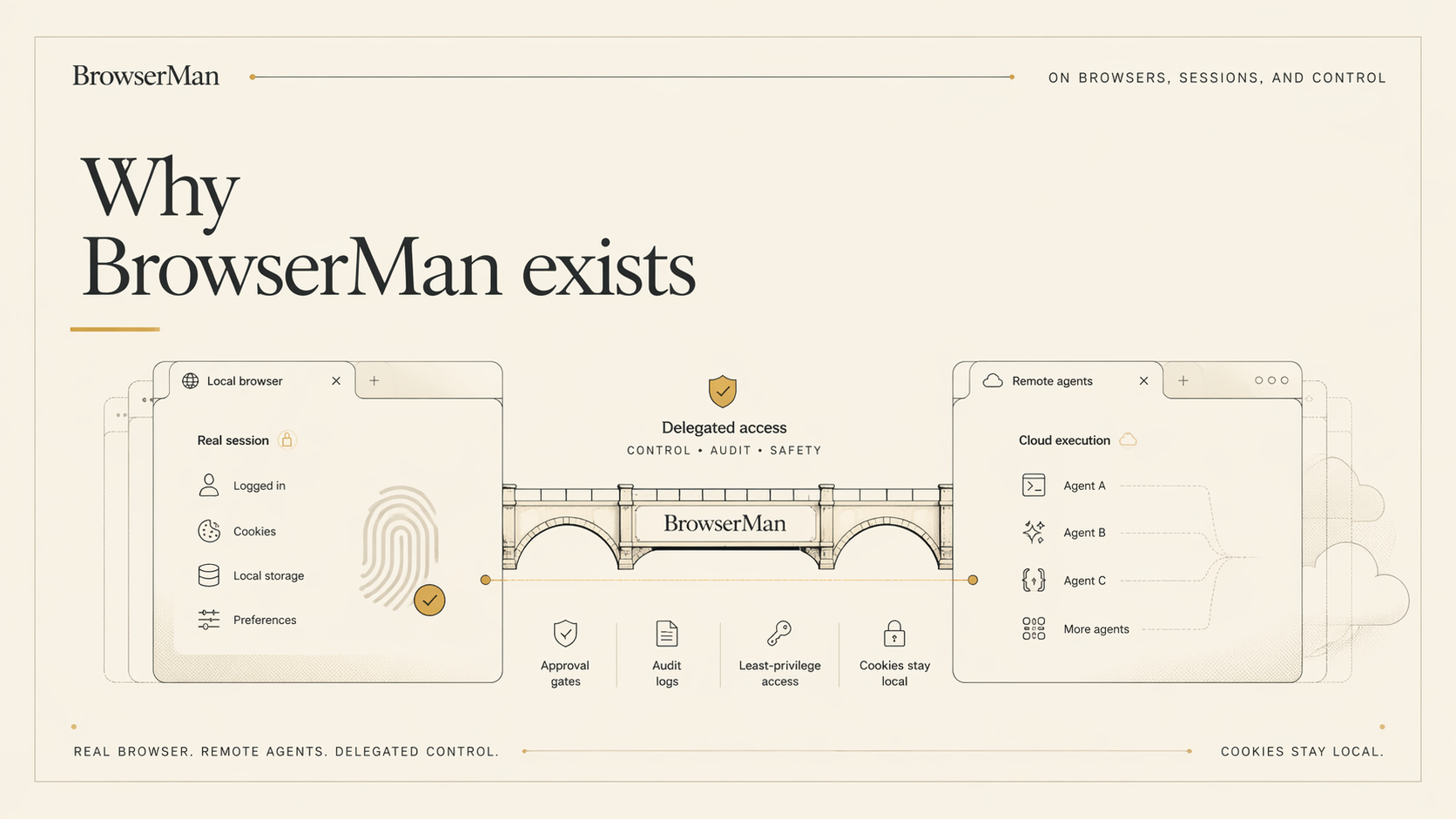
BrowserMan exists because today’s browser tooling stack splits in the wrong place.
One category gives agents access to a real browser. Another lets agents run from anywhere. Most teams still have to choose between them.
That tradeoff breaks real workflows.
The split in the market
Local browser tools are useful when the workflow depends on the browser you already use. They can often access your real tabs, cookies, and logged-in sessions.
But they usually assume the agent is running on the same machine. Once the agent moves into the cloud, onto a server, or into a scheduled workflow, that model starts to fail.
Cloud browsers solve a different problem. They let remote agents run browser workflows from anywhere.
But they do it in a different browser environment, not the one you actually use every day. That means the workflow often loses the thing that mattered most: the real session.
Why the real session matters
A surprising amount of useful work depends on the browser state you already have.
That includes:
- social accounts that are already logged in
- publishing tools with active sessions
- community dashboards
- admin panels
- internal web apps
- workflows spread across multiple tabs
In practice, the hard part is often not clicking buttons. The hard part is getting an agent into the right authenticated context without turning the process into a security and operations mess.
Teams try to work around that in all the wrong ways.
They share passwords. They pass cookies around. They rebuild sessions in disposable environments. They settle for partial automation because handing off the real workflow safely is too painful.
That is the gap BrowserMan is built for.
BrowserMan’s model
BrowserMan connects your real Chrome browser to an AI agent.
That gives you three things at once:
-
Real logins The agent can work inside the browser context you actually use.
-
Agents anywhere The agent does not have to live on the same machine as the browser. It can run locally, remotely, in the cloud, or on a schedule.
-
Cookies stay local The real session stays in your browser environment instead of being copied into a separate cloud browser.
That combination is the point.
BrowserMan is not just another browser automation tool. It is an access layer between AI agents and a user’s real browser environment.
Browser automation is only part of the problem
A lot of browser tooling talks about automation as if the challenge is only technical. Can the agent open a page, read content, click a button, or submit a form?
That matters, but it is not the whole story.
In real use, teams run into a more important operational question:
How do you let an agent or outside operator act in a real logged-in browser context without giving up control?
That is why BrowserMan is built around delegated access, not just browser control.
The important ideas are:
- scope what an agent can touch
- audit what it did
- revoke access when needed
- keep the user’s credentials in the user’s browser environment
That makes BrowserMan useful not only for builders, but also for operators, marketers, and teams that need real work done inside real accounts.
Where this matters first
The clearest use cases show up anywhere the real browser matters more than a fresh browser.
Examples:
- an agent drafts or posts through a real social account
- a remote workflow operates inside a logged-in dashboard
- a vendor or teammate gets scoped browser access instead of a password
- a scheduled agent checks a real browser-based workflow every day
These are not edge cases. They are exactly the kinds of jobs people try to automate once AI agents become useful.
Why BrowserMan exists now
AI agents are getting better at using tools. But better reasoning does not solve the browser access problem by itself.
If the agent cannot reach the real browser context, the workflow is still limited. If the only way to reach that context is unsafe or awkward, teams will stop short of full adoption.
BrowserMan exists to remove that bottleneck.
We think the future is not just agents with more tools. It is agents with the right level of access to real environments, under real control.
That starts with the browser.
What comes next
We will use this blog to explain this category more clearly.
That includes writing about:
- real-browser access for agents
- delegated approvals and scoped permissions
- practical social and operations workflows
- how BrowserMan compares with local browser tools and cloud browser setups
Because this category is still new, clear language matters.
And the simple framing is still the right one:
Local browser tools can access the real browser. Cloud browsers can serve remote agents. BrowserMan exists because real workflows need both.